
BUILD · CRM + FOLLOW-UP
Why I Moved Our Real Estate Database to HighLevel.
We had years of contacts, leads and history inside an established real estate CRM. Moving roughly 23,000 records was not something I wanted to do for fun.
I did it because the job we needed the platform to do had changed.
ACTUAL IMPLEMENTATION · ~23,000 CONTACTS MIGRATED · CASE STUDY · UPDATED SEPTEMBER 2026
THE OLD STACK
Sierra Interactive wasn’t the problem.
The previous platform had been embedded in the business for years. It held a real estate database, supported our existing workflow and was part of the system we had built around it.
There are things a real-estate-specific platform does very well. If the goal had simply been to keep running the same process, I might not have moved.
It was: does the current platform give us enough control over the follow-up system we are trying to build now?
THE REAL PROBLEM
Our CRM needed to do more than hold leads.
The business needed a stronger connection between the database, lead routing, segmentation, automation and the ongoing work of follow-up.
DATABASE
One working place for contacts, history, segmentation and opportunity.
AUTOMATION
Workflows built around what should happen next—not a process frozen in place.
COMMUNICATION
Email and SMS connected to the contact and the actual follow-up plan.
FLEXIBILITY
Processes designed around the business rather than adopting a generic workflow.
INTEGRATION
Forms, IDX activity and other sources feeding the broader operating system.
WHAT THAT MEANS IN PRACTICE
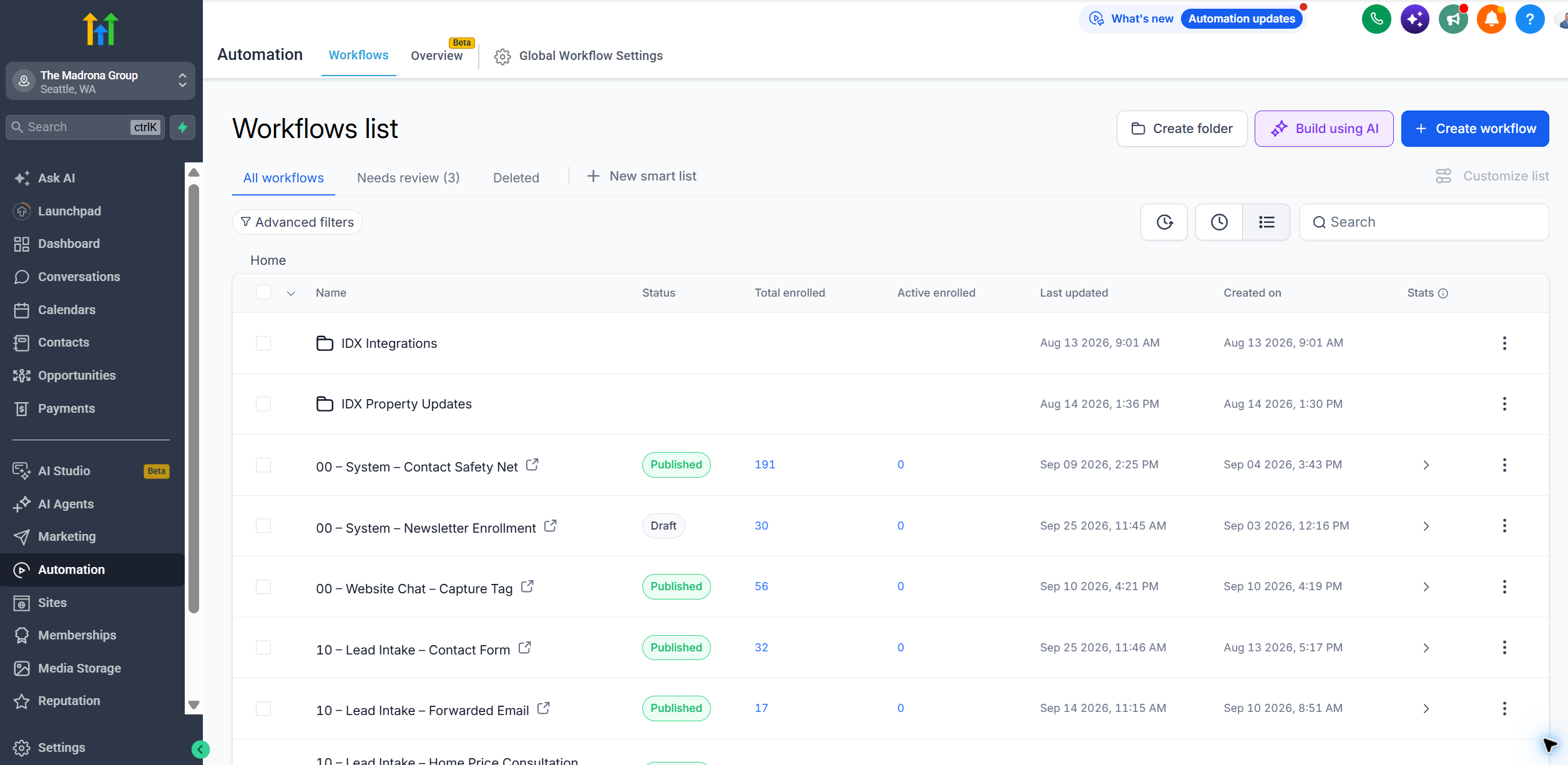
What we are actually building inside HighLevel.
HighLevel is not valuable because it has more screens. It is valuable when the database, workflows and follow-up behavior can be designed to work together.
WORKFLOWS
The current library is where the intended next step becomes repeatable instead of depending on memory alone.
PIPELINES
Opportunity stages make the next conversation visible—so leads have a place in the process, not just a place in a database.
A de-identified pipeline view will be added before publication.
CONTACT RECORD
The goal is a usable relationship history: source, context, communication and the next useful action in one working view.
A de-identified contact view will be added before publication.
THE MOVE
Moving 23,000 contacts changes how seriously you evaluate a CRM.
A migration of this size is not a file-transfer project. It is an operating decision about what history, context and behavior should come forward into the new system.
WHAT WE MOVED
Contacts, core contact information and the relevant history needed to keep relationships and follow-up connected.
WHAT WE DIDN’T JUST COPY
Old workflows, stale structure and anything that did not deserve to be recreated simply because it existed before.
WHAT THE MOVE FORCED
A clearer decision about what information mattered, how people should be segmented and how nurture should be rebuilt intentionally.
The key lesson: A CRM migration is an opportunity to decide which parts of the old system deserve to come with you—not a reason to reproduce every old habit.
THE HARD PART
HighLevel didn’t magically make the migration easy.
Migration work exposes the parts of a business that have been hidden inside a database: inconsistent data, old process assumptions and workflows that are no longer worth defending.
The difficult work is not just importing records. It is deciding what should be cleaned, what should be rebuilt and what should be allowed to end.
A less turnkey platform asks more of the operator. The implementation only gets better when that work is treated as a redesign, not a copy-and-paste exercise.
WHAT CHANGED
The move gave us more control over what happens next.
Different lead sources can enter different follow-up paths. Long-term nurture can be structured more deliberately. The database is no longer merely somewhere contacts sit until someone remembers to act.
That is the payoff: a better connection between the moment a lead raises a hand and the follow-up the business has decided should happen next.
THE REAL ESTATE PIECE
HighLevel isn’t an IDX.
It is central to the follow-up system, but it does not replace every piece of the real estate technology stack.
That architecture is intentional: a platform can be central without pretending it should do every job.
WHAT HIGHLEVEL DOESN’T REPLACE
One platform is not the entire stack.
- IDX Broker for property search.
- WordPress for the public website and publishing.
- Brokermint for transactions and compliance.
- QuickBooks for accounting.
- Gusto for payroll and people operations.
- Semrush for search and visibility work.
WHO I THINK IT FITS
HighLevel is powerful because it is flexible. Flexibility creates complexity.
I WOULD LOOK AT HIGHLEVEL IF…
- You want control over follow-up workflows.
- You have multiple lead sources.
- You need deeper automation than a basic contact database.
- You are willing to configure and maintain the CRM.
I WOULD PROBABLY LOOK ELSEWHERE IF…
- You want a completely turnkey system.
- You hate configuring software.
- You expect one tool to be a website, IDX and CRM all at once.
- You want the simplest possible database.
THE RELATIONSHIP
If you want to try HighLevel.
I use HighLevel in my own business and I am also a HighLevel affiliate. If you sign up through one of the links below, I may receive compensation at no additional cost to you. The affiliate relationship came after the decision to use the platform; it is not why we moved the database.
If your business looks more like the use case I’ve described here, you can explore HighLevel for yourself.