
Build · SEO + Technology
How I Actually Use Semrush for Real Estate SEO
Semrush helps me decide where to focus. It doesn’t decide what I should say.
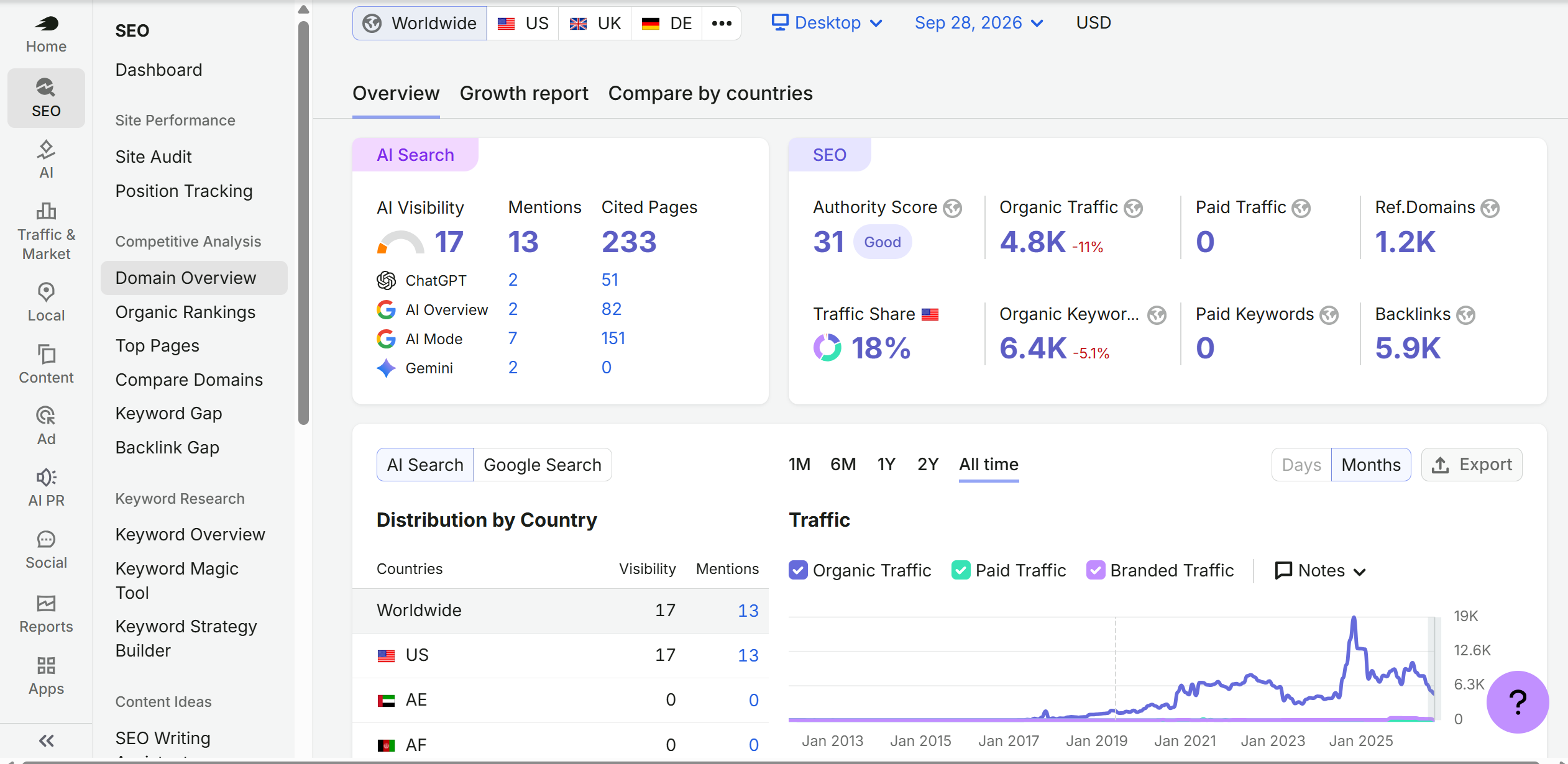
This is a look at my real research workflow while rebuilding JasonFox.me and thinking through real estate content—not a list of every button in the software.
The useful distinction
Research is not a marketing plan.
I’ve worked on real estate marketing long enough to know that a keyword list can become a distraction. The hard part is choosing the pages that deserve to exist, making them useful, and connecting them to a business that can actually serve the reader.
I use Semrush to explore search demand, compare competing pages, find gaps, and monitor visibility. Then I use my own experience—and actual site data—to decide what to build or improve.
For agents, the goal isn’t to win a dashboard. It’s to become a useful local resource and turn relevant interest into real conversations.
The five jobs
Where Semrush earns its place in my workflow.
I use the tool to make decisions in a sequence. A search term is only interesting if I can make a page that truly helps the person behind it.
Keyword research
I look for the language people actually use, then ask whether the intent fits something I can explain from experience. Volume is context, not the assignment.
Competitor research
I compare the pages already showing up: what question do they answer, where are they thin, and what perspective could I add? The point is to spot the gap—not copy a competitor.
Content opportunities
Research helps me see when an old article should be rebuilt, when a new page belongs in the library, and which related pages should link together.
Ranking tracking
I watch directional changes for important topics, especially after a substantial rewrite. A position can move; the more important test is whether the page earns useful visits and conversations.
Site and SEO research
Technical issues and weak page structure can hold useful work back. I use research to prioritize what needs attention instead of treating every warning as equally urgent.
Editorial judgment
I still have to know the audience, the business, and the answer. Semrush is a research instrument; it is not the strategy or the writer.
From the current rebuild
What this looks like on JasonFox.me.
I’m not starting with a blank site. I’m rebuilding years of real estate marketing content into a clearer system, one page at a time.
Real estate marketing ideas
The search opportunity was real, but a generic list would add very little. I rebuilt the piece around the jobs marketing needs to do and the few activities an agent can repeat consistently. See the marketing ideas page →
Local SEO for agents
Visibility is not just a ranking number. The page now explains how to become useful in a local market, with clearer connections among content, Google Business Profile, site structure, and follow-up. Read the local SEO article →
IDX and the website
Search demand can point toward an IDX question, but a useful answer also has to address the visitor experience and what happens after someone registers or asks about a property.
Marketing tools and lead response
These topics only matter if the recommendation is connected to a real workflow. I use research to find the question, then write from implementation and experience—not a vendor feature list.
The pattern: find an actual question, decide if I have a credible answer, improve the page, connect it to the right next step, and measure what happens. That is a system. Publishing more pages by itself is not.
My decision filter
Relevance comes before search volume.
Before I choose a topic, I ask five questions in this order.
1. Relevance: Is this a question my intended reader actually has?
2. Intent: What are they trying to decide or accomplish?
3. Authority: Can I answer from real experience or strong evidence?
4. Distinctive value: Can I make the result clearer or more useful than what exists?
5. Competition and volume: Is the opportunity worth the effort right now?
That order keeps me from chasing a large keyword that doesn’t belong on JasonFox.me—or publishing a shallow page simply because a tool found an opening.
What I do not ask it to do
The dashboard doesn’t get the final vote.
I don’t use a difficulty score as a veto on a topic I genuinely need to cover. I don’t ask an estimate to stand in for actual Search Console results. And I don’t let a content tool manufacture a first-person opinion I haven’t earned.
Those are boundaries for the workflow, not a claim that every other Semrush feature is bad. I use the parts that help me choose and improve useful work; the rest can wait.
My current verdict
A useful tool, not a shortcut.
I keep using Semrush because it helps me ask better questions about search and choose my next move more deliberately.
The question I would ask before buying it is not “How many features does it have?” It’s “Will I use the research often enough to make better decisions?” If the answer is no, start with Search Console, your actual customers’ questions, and a consistent publishing and follow-up system.
This is my Semrush affiliate link. I may earn a commission if you sign up through it, at no extra cost to you.
Keep building
Tools work best inside a system.
SEO is one part of a durable real estate business. The pages below show how I connect visibility to the website, technology, marketing, and the next conversation.
Clear about the relationship. I recommend tools based on how they fit the work, not on whether they pay me. Some links on JasonFox.me may be affiliate links. The Semrush link on this page is an affiliate link. I may be compensated if you sign up through it, at no extra cost to you. That relationship does not determine my recommendation.