

You don’t need your real estate website to rank for everything. You need the right people to find you when they’re searching for homes, neighborhoods, market information and real estate help in the places you actually serve.
After years of building real estate websites and publishing local content, I think about SEO less as a list of tricks and more as a way to make useful local knowledge findable. A good page should answer a real question, show that you know the place, and give someone a sensible next step.
Six things I would build first.
A complete Google Business Profile
Accurate business details, appropriate categories, services, hours, photos and a website link.
Genuine client reviews
Real experiences, requested without incentives or scripted wording, plus thoughtful responses.
Useful local content
Pages that answer the questions buyers and sellers actually ask in your market.
Strong neighborhood pages
Original context about homes, tradeoffs, prices and life in a specific place.
A technically sound website
Fast enough, mobile-friendly, indexable and easy to navigate.
A connected local architecture
City, neighborhood, market and question pages that help a reader move naturally.
Local SEO is less about sprinkling city names onto pages and more about proving that you’re genuinely useful in a specific market.
Make your real business easy to recognize.
A Google Business Profile is not a substitute for a website, but it is often the first place a local searcher meets your business. Claim and verify the right profile. Use your real business name, accurate contact details, relevant categories and services, current hours and photos that reflect the work you do.
For an agent or brokerage, the location and service-area setup must reflect how the business actually operates. Don’t create a fake office or a second profile just to appear in another neighborhood. Choose categories because they describe the business, not because they contain a keyword you want.
Google says local results mainly depend on relevance, distance and prominence; there is no way to pay for a better local ranking. Complete, accurate information and useful photos help people understand whether you’re the right fit.
Google’s local ranking guidance →Business Profile guidelines →Ask real clients. Let them use their own words.
The first reason to earn reviews is human trust. A review saying “Jason was amazing” is welcome. A genuine account of how an agent helped someone sell in Ballard while navigating a complicated move tells a future client more. It gives context—not just a star count.
Ask clients who actually worked with you. Make the review link easy to find. Respond professionally, including when the feedback is mixed. Don’t offer incentives, ask only happy clients, or tell people which phrases to include. The details that matter will appear naturally when people describe their experience.
Google’s policies require reviews to reflect real, unbiased experiences and prohibit incentives and scripted content. That’s also a better standard for a business built on relationships.
Google’s review policy →Write the page that someone who lives there could have written.
This is where local content stops being a generic blog schedule and becomes an asset. A strong page helps someone make a decision about a particular place.
Broad topics have their place
“10 Tips for First-Time Homebuyers” may be useful, but it could come from almost anywhere. If every local page swaps the city name and keeps the same copy, the site hasn’t really added local knowledge.
Specific questions are stronger
What does an $800,000 budget buy in Ballard right now? What should a buyer know about Mukilteo? How does a Seattle condo market shift affect monthly costs? What actually changes when someone moves from Seattle to Tucson?
Publish market reports with dates and sources. Update them when conditions change. For neighborhood guides, discuss housing types, commute patterns, amenities and meaningful buyer questions without making unsupported claims about schools, safety or who a neighborhood is “for.”
Make sure the site can deliver.
Good content still needs a functional site. Check the mobile layout and load time. Give each important page a descriptive title and one clear H1. Use readable URLs, descriptive image alt text, working internal links and a sitemap. Make sure the pages you want found can be crawled and indexed.
Watch for accidental noindex settings, duplicate URLs with conflicting canonicals, broken links and huge images. Use structured data where it accurately describes visible content, but don’t expect markup to rescue a thin page.
My working stack includes Google Search Console for search performance, Semrush for research and competitive context, Rank Math for on-page settings, WP Rocket for performance work and Cloudflare at the edge. None of those tools replaces judgment about what a local buyer or seller needs.
See my real estate technology stack →Let Search Console tell you where Google is already giving you a chance.
Instead of guessing what article to write next, I pay attention to the searches where Google is already showing the site.
In Search Console, I look at a page’s queries, impressions and clicks. An impression means a link was shown in search; a click means someone visited from it. If a relevant query has impressions but few clicks, I look at the title, description and whether the page actually matches the searcher’s question. If a page earns clicks, I look for the next useful piece or better internal path.
That is why I’m revisiting subjects such as real estate marketing tools, lead response, WordPress IDX and local SEO. These are real questions that connect to the systems I work on, not a random list of keywords.
- Find a relevant query or page with impressions.
- Read the live page as a visitor would.
- Improve the answer, title, structure or next step.
- Check the result over time without treating one week as proof.
Search Console reports clicks, impressions, CTR and average position. Those are different measures; none by itself proves that a page produced a client.
Research supports the work. It doesn’t choose the work.
Semrush helps me examine search themes, competing pages and technical issues. I use it alongside Search Console, which shows what is actually happening on my own site. A keyword estimate can suggest an opportunity; it cannot tell me whether I have something useful to say about that market.
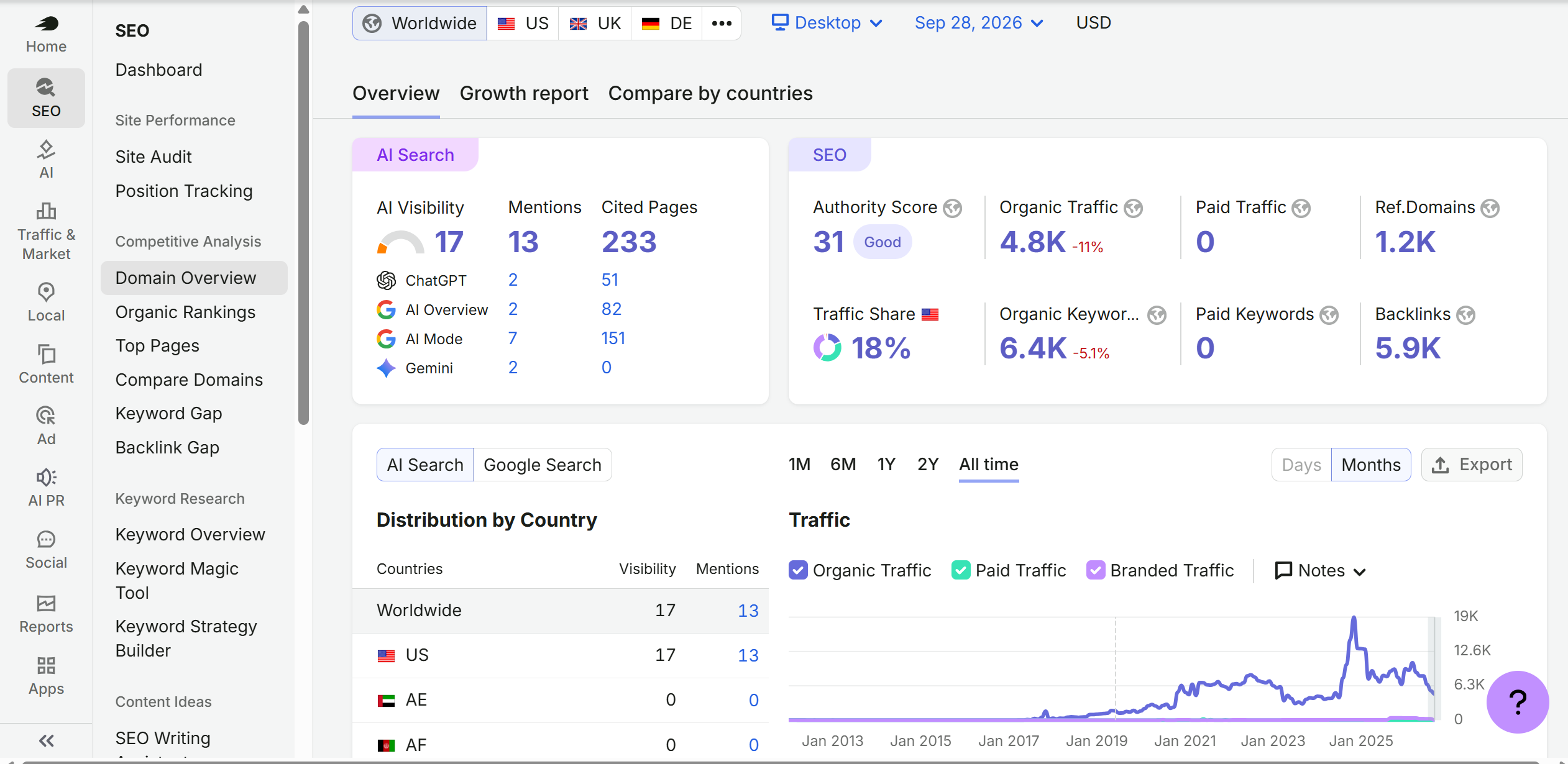
My question is always: can I add firsthand experience, local context or a clearer answer than what’s already there? If not, another tool report won’t make the article worth publishing.
The deeper walkthrough of how I use Semrush belongs in its own article. On this page, it is one tool in a larger editorial and technical workflow, not the main pitch.
The tools behind my work →Make expertise easier to understand—not easier to fake.
Google’s AI experiences and other search assistants may change how someone discovers a local answer. I wouldn’t respond by inventing “AEO hacks.” I would make the business identity accurate, write clear factual answers, identify the places I actually serve, and put original experience into pages that a reader can verify.
AI can help organize research or a draft. It should not produce hundreds of thin neighborhood pages that pretend to know a market. Google says its AI search features still draw on core Search systems and recommends useful, non-commodity content over tactics aimed at AI alone.
The strategy isn’t to trick a new kind of search engine. It’s to make local expertise easier for machines and humans to understand.
Google’s AI Search guidance →More pages and more keywords are not automatically progress.
A location-based domain can be memorable. It does not give you an inherent local-ranking advantage just because it ends in .realestate.
Local SEO for real estate agents: FAQ.
What is local SEO for real estate agents?
It is the work of making a real estate business and its useful local pages easier to find for people searching in a specific market. It includes accurate business information, relevant content, a technically sound site and paths from a search answer to the next useful action.
How long does real estate SEO take?
There is no reliable universal timetable. Fixing a technical error can help quickly; earning visibility for competitive local topics usually takes sustained publishing, maintenance and measurement. Compare your own Search Console trends over months, not a single week.
Does Google Business Profile matter for Realtors?
Yes, when the business is eligible and the profile accurately represents it. A complete, verified profile helps people understand the business and may appear in local search and Maps. Use the real location and service-area setup, not a fabricated office.
Do real estate reviews help local SEO?
Google says reviews are one factor in local prominence. More importantly, genuine client stories help future clients judge the service. Ask without incentives, selective solicitation or scripted wording.
Does IDX help SEO?
IDX can make property search useful and may create discoverable pages, depending on the implementation. Shared listing inventory does not replace original local expertise, sound site structure or helpful buyer and seller content.
What local content should an agent create?
Start with questions that come up in actual conversations: neighborhood tradeoffs, current market context, buying or selling decisions, property types and local processes. Use dates, sources and firsthand examples where possible.
Should every neighborhood have its own page?
Only if you can make each page genuinely distinct and useful. A thin template with a swapped place name is unlikely to serve a reader well. Prioritize the places you know and maintain.
Do agents need backlinks?
Relevant links and mentions can help people discover a business and contribute to its prominence. Earn them through genuine local relationships and useful resources; don’t buy low-quality links to manufacture authority.
What SEO tools do I use?
Google Search Console, Semrush, Rank Math, WP Rocket and Cloudflare have different jobs in my workflow. I use them to understand search demand, improve pages and keep the site healthy—not as substitutes for original work.
Does AI change local SEO?
It changes some search experiences, but the foundation remains accurate business details, clear answers and original expertise. I don’t know a shortcut that makes generic content local simply by rewriting it for AI.





Understanding Google rankings is vital for any real estate agent aiming to expand their digital reach. By focusing on SEO fundamentals like relevance, authority, and user experience, agents can build a strong online presence to attract more potential clients.